
A breath strip can dissolve quickly and leave a cooling feeling afterwards. Those are two different experiences. A third question—how long breath odour is reduced—needs different evidence. Understanding the difference helps you choose a freshener without reading more into a number than it actually measures.
Three clocks, three different questions
| Claim | What it describes | What it does not establish |
|---|---|---|
| Dissolving time | How long the thin film takes to dissolve under the test conditions | How long the cooling feeling lasts |
| Cooling duration | How long participants report a cool sensation | How long odour is controlled or bacteria are reduced |
| Odour-control duration | A measured change in breath odour over time | Something that can be inferred from a mint taste alone |
Why does mint feel cool?
The National Cancer Institute’s menthol definition describes the cooling sensation menthol can cause when consumed. That explains why menthol is relevant to a mint product’s sensory experience. It does not validate a particular product’s duration, formulation or performance.
Think of “cool” as a description of what you feel. It is not a home test for the cause of bad breath, and the point at which you stop noticing mint is not proof that your breath has suddenly changed.
How to read Freegrin’s 180+ seconds message
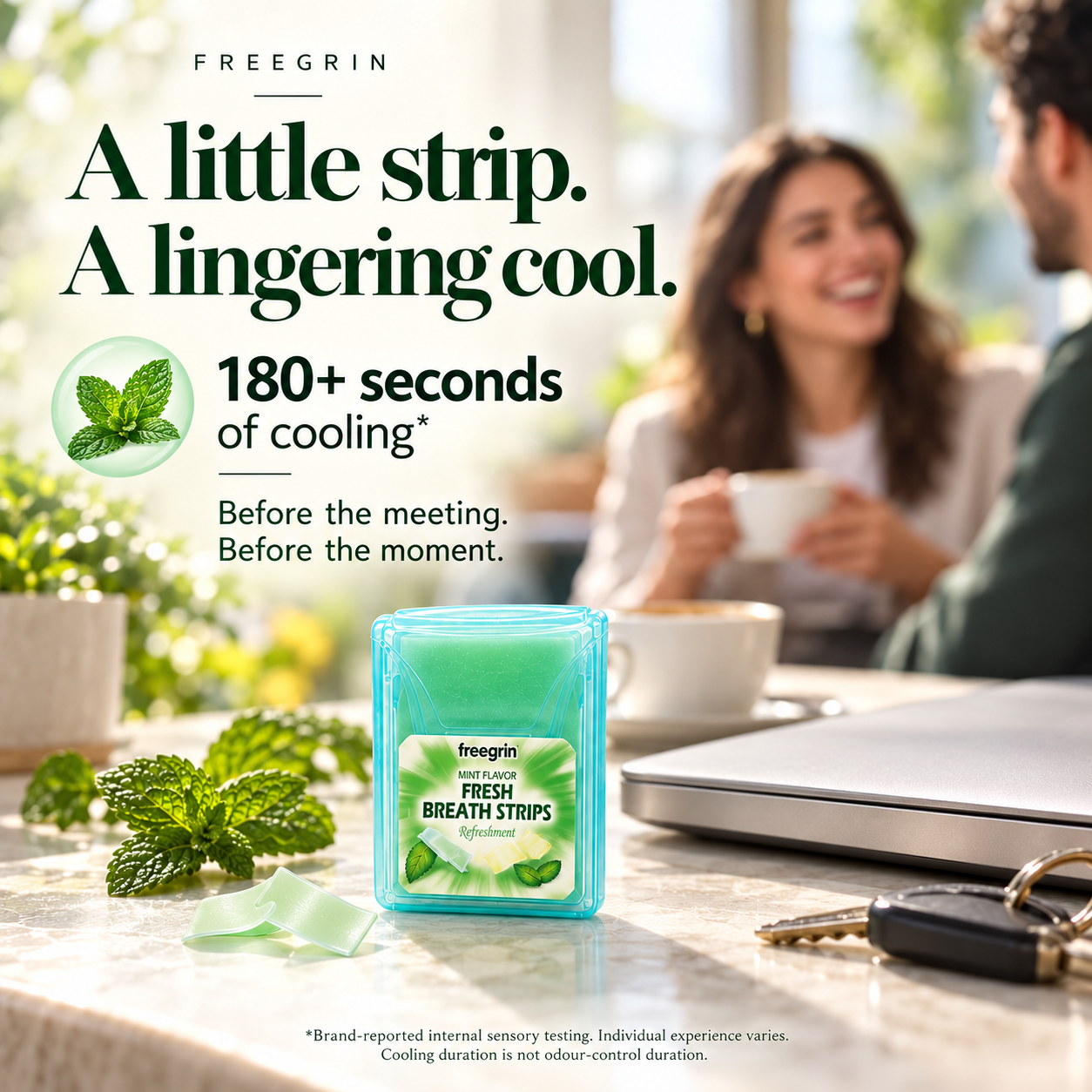
The Freegrin Mint Breath Strips product page describes 180+ seconds of mint cooling as a brand-reported sensory observation. Read it as a cooling claim, not a guarantee that every person will experience the same duration, and not a claim of 180 seconds of measured odour reduction.
A useful test explanation would state the product and batch, number of participants, instructions, start and end points, and how results were recorded. A headline number without those details should not be treated as a clinical finding or proof of superiority over another product. Individual experiences can differ; follow the instructions supplied with your own pack.
What would make two duration claims comparable?
Before choosing by the longest number, check whether both claims measured the same thing. One might describe flavour, another cooling, and a third laboratory measurements. Even two cooling observations may use different definitions of when the sensation ends.
- Was the exact flavour and formulation identified?
- Was the result typical, an average, or the longest observation?
- How many people took part?
- Were conditions and scoring methods consistent?
- Was there a direct comparison with the other product?
If those answers are absent, compare practical features you can verify instead: format, ingredients on the current label, pack count and whether the pocket case suits your routine. A stronger sensation is not automatically better for your needs.
Choose for the moment, keep your care routine
For a meeting or a journey, a small dissolving strip may be a convenient freshening format. Freegrin Mint is listed as 12 pocket packs with 20 strips each; the breath strips range lets you check available flavour options. For handling opened cases, see our pocket-pack organisation guide.
Fresheners do not replace daily oral hygiene. The American Dental Association’s bad-breath guidance recommends brushing twice daily, cleaning between teeth daily, and seeing a dentist if you are concerned about the cause. A lingering mint sensation should not delay that check.
The useful takeaway
Read a cooling number as a sensory description. Look for the method behind it, and keep dissolving speed, cooling duration and odour-control evidence separate. That makes the promise easier to understand—and the product easier to choose for your own day.